TEN ROMEO NEWSLETTER
NORTH POLE PROJECT, Report 3
August 4, 1986
Dear Friends:
By the time this reaches you, I will be flying northern skies for the North Pole in TEN ROMEO!
But - just a few items to bring to your attention before my departure on August 5th.
Three weeks ago I focused upon the maps of the region to be flown on the present project. MIGHTY DESOLATE! I called a friend and indicated I really needed more than an astrocompass for the trip ahead, particularly to position the transmitter drop as close to the Pole as possible.
AND - a real miracle came about! Arrangements were made for a GPS to be placed aboard TEN ROMEO. The unit obtained is a COLLINS NAVCORE I. It operates with satellites, and with seven in place, we will have to be careful about our ''window'', but that equipment certainly lifted a load off my mind.
It seemed appropriate to send the ARNAV AVA-1OOO back to the factory for a final tuning before the trip North. A special antenna was added to enhance the possibility of reading the northernmost transmitter of the Norwegian LORAN-C chain.
The AVA-1000 was returned to me on July 25th, and on July 27th I left Albany on a test flight of the equipment that would take me almost as far as the North Pole trip.
Each of the legs flown during the next four days were filed IFR, and under the ''remarks" section it was indicated direct routing was requested to test long range navigation equipment. The FAA approved the request, and each of the legs were flown by the equipment "hands-off''. The AVA-1000 kept Ruth and me right on track with a minimum of scalloping. A great piece of equipment!
Monday morning I was at the COLLINS shop in Cedar Rapids at 7:30, and installation of the NAVCORE I began. What a great group of people those COLLINS folks are! Installation went beautifully, and the next morning we flew to Des Moines for FAA approval. When we returned to COLLINS, the astrocompass mount was complete, and I was on my way to KING at Olathe, Kansas. (What a great crew you have, Bob. Ruth sends particular thanks to Dwight, and I send my thanks to everyone.)
Incidentally, the media coverage at Cedar Rapids was great. A nice section on the 6:00 p.m. TV News Monday, and a feature article on the front page of the GAZETTE Tuesday morning. I left COLLINS with great respect for their craftsmanship and delight with the user-friendliness of the NAVCORE I.
I called my friends at KING with the hope that my KING 950 High Frequency radio might be checked. Craig was absolutely great. "Drop by our hangar and we'll do the check immediately upon your arrival!" How's that for "product support"?
All components were bench-checked, and the installation reviewed. It was determined that repositioning the antenna would improve communication capability, and this was done with the desired improvement we were looking for. (Grateful thanks to you, Gil, and everyone who helped on that quick, effective job!)
Upon return to Albany, my first task was to check on the progress of our modified radio transmitter for the Pole drop. It was disappointing to learn that approval by the FAA on the new generation package had been delayed, and a special drop transmitter would not be available.
I immediately called NARCO, another one of my EQUIPMENT SPONSORS, and found most of my friends were at OSHKOSH, BUT - I connected with just the right person who was home minding the store, and explained my problem. I requested a standard ELT with a switch which would activate the radio before deployment, and then silence the unit in 315 minutes.
John pulled a miracle out of his pocket!
"We happen to have a unit that is fully approved, and especially designed to generate a two second solid carrier specifically for satellite pick-up. This unit is so new that we have not yet deployed any to the field. We could rig one for your use with the proper switching, and consider your drop our first field-test of the unit in as hostile environment as the North Pole!"
We discussed options on antennas and reviewed drop procedure. It was determined that I would fly to the Pole with two units properly rigged. If the first unit is damaged on impact (we are using a small chute) we'll kick out the second.
A cablegram was immediately sent to my Soviet satellite friends, with copies to appropriate people who have a need to know of our plans. A copy of this message is a part of this report.
On Thursday, July 31, TEN ROMEO was put in the PAGE shop for a 100 hour inspection on the engine. A slight oil leak developed on the trip west, and it appeared to be a failure of the Garlock seal on the alternator. This seal was replaced, new sparkplugs installed, but the engine check revealed poor compression on the #5 cylinder. The jug was pulled, the valves repaired, and everything is back together and working fine.
It might be well to mention that the inside of the engine was clean as a whistle! The inside looked like a new engine, in spite of its 1100 hours of operation. This is probably due to the Shell W15-50 oil I've used (better tell SHELL about that), as well as the heavy throttle and RPM I've been using in my record flying.
Insurance came in for the trip at about twice what was expected, but far better to have the insurance than to fly the trip "bare".
A few odds and ends.
Steve Honeybill, who will be flying as the astrocompass expert, has arranged to have a new generation light weight TV camera aboard. This unit is a marvel, and even better, I understand, than the unit used for the documentary Channel 17 TV film, FRIENDSHIP FLIGHT. Perhaps there will be another documentary on this next venture of ours!
Many thanks to you, Wayne! The maps are great!
I should mention that I contacted US military headquarters in Colorado. I indicated I would be flying in their skies soon and gave them our "window". While I have no plans for using any of the DEW Line sites, it seemed proper to make sure my plans were known. What a warm reception we had. "We know you are not planning to use any of our facilities, but consider the latchstring out should you need an alternate. Furthermore, we'll arrange to communicate with you and will keep you on our radar."
Contact with the Canadian military was also warm and cordial.
The drop package will be deployed with a small chute, and we will drop it from the rear door. I called BEECH recently and asked if their engineers could provide information on handling characteristics of the BE-36 with the rear door open. They did some checking, and came back with, "We don't have any information on that. We've flown with the rear doors off for parachuting, but have had no occasion to crack that front rear door."
Sooooo - Steve and I did some test flying, and a copy of our report to Beech Aircraft Corporation, is enclosed.
Careful consideration was given to establishing a NOTAM on our ELT drop at the Pole. However, since the signal is so brief, the relative number of Polar commercial flights limited, and careful contact made with the US and Canadian military, as well as Don McQuinn, of Transport Canada, we felt we had properly covered the bases.
Contents of the drop package are rather interesting, but there will be more time to mention this in my next report.
Our route is planned as follows: Albany to Quebec City, Quebec City to Frobisher Bay for overnight, then Frobisher Bay to Resolute Bay, Resolute Bay to Eureka where we will wait for an OK from the weather people for our dash to the Pole.
It would be our hope to make the round trip from Eureka to the Pole and back - a distance of 1202 nm - with as much sun as possible. We plan on the trip taking no less then six hours and no more than eight hours. We will have fuel for twelve + hours.
The trip home is planned as Eureka to Frobisher Bay to Albany. Each leg will be flown for a record.
In closing this report, I want to share with you a particular phase of this project which I find mighty exciting.
As you know, this is the 300th birthday of Albany, New York, which is the oldest city in the United States operating under its founding charter.
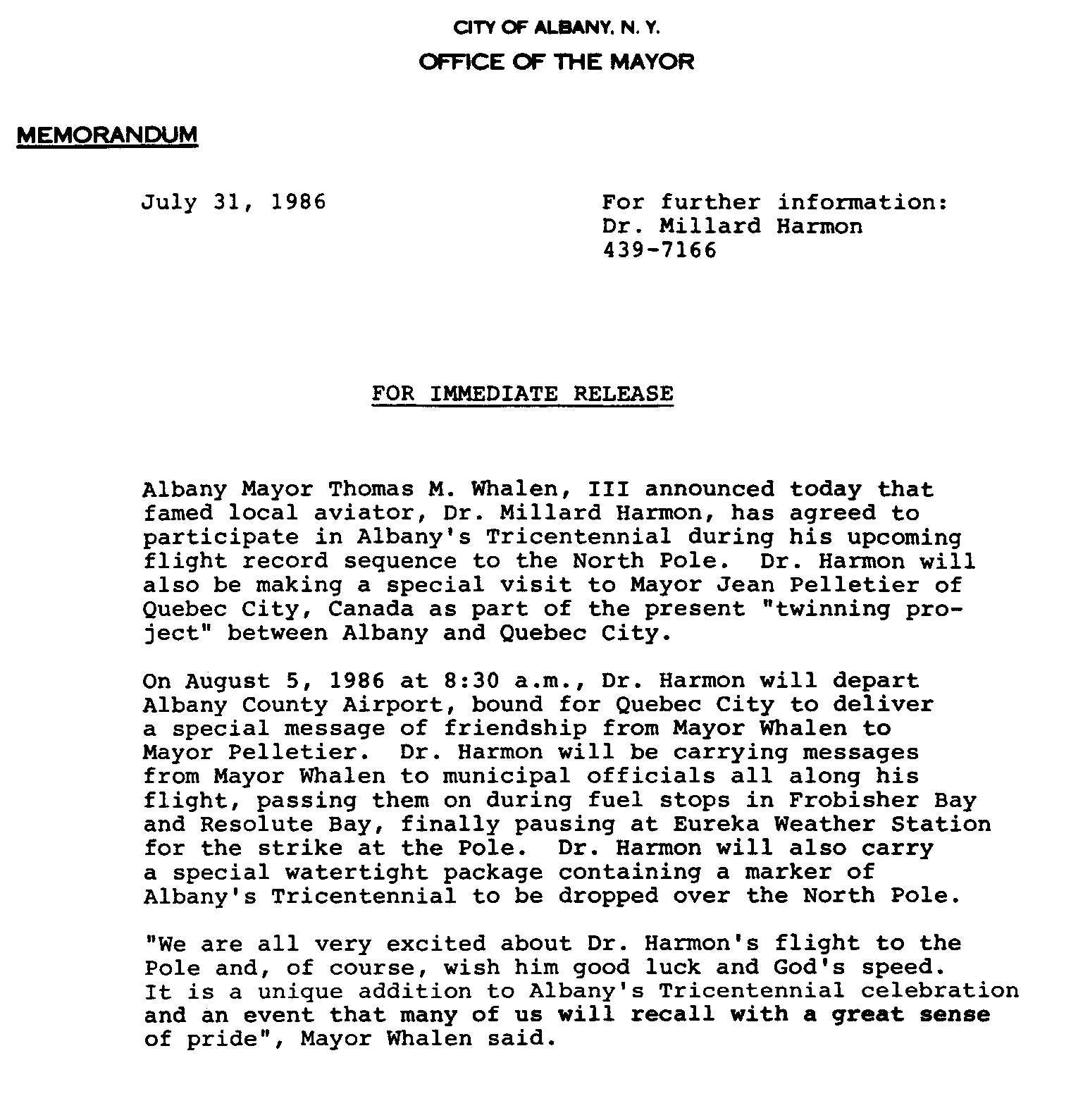
In December I contacted Mayor Thomas M. Whalen, III, asking if it might be interesting to tie TEN ROMEO's record shot to the North Pole in with the Albany Tri-centennial celebration.
Arrangements have worked out well along this line. A planning meeting was held in the Mayor's Office last month, and I was invited to take part in the special arrangements to welcome Mayor Jean Pelletier, of Quebec City, and his delegation when they arrived to sign the "Twinning" document between Albany and Quebec City. Mayor Pelletier and his group were gracious and interested in TEN ROMEO's project to the Pole.
As a result, Mayor Whalen will be using TEN ROMEO as a FRIENDSHIP BRIDGE implementer during the next few days.
Tomorrow morning, the record run from Albany to Quebec City will serve as a further link in the Albany/Quebec City "Twinning" program. I will deliver gifts and warm greetings from Mayor Whelan to Mayor Pelletier. Also - I have Proclamations and gifts from Mayor Whalen to each of the city leaders of the fueling stops we will use.
Delmar is a suburb of Albany, and it is a real pleasure to extend the right hand of friendship to the leaders along our route from our beautiful tri-centennial city.
And with this, I will thank all of you for your interest and support. How satisfying it is to use that aircraft of mine as a factor in building FRIENDSHIP in ever new and divergent ways. Who knows - perhaps TEN ROMEO's next project will be to build FRIENDSHIP BRIDGES between Albany, New York, and each of the other cities named ALBANY in the continental United States. (Ruth was mighty pleased that I made no mention of the Albany communities in Australia and New Zealand!)
Report #4 will come to you following my North Pole experience. Wish us luck, and warmest regards!
------------------
Time Line on TEN ROMEO to the North Pole - an Albany, New York, Tri-centennial Celebration project.
| 12/18/85 | Contact with Albany City Hall exploring possibility of Pole Record Strike a tri-centennial project |
| 5/21/86 | Planning session with Blue Chip Advisory Committee |
| 5/28/86 | Moscow trip to arrange ELT drop at North Pole |
| 7/2/86 | Meeting with Mayor Whalen to set final details of coordination of TEN ROMEO TO THE NORTH POLE project with tricentennial activity |
| 7/18/86 | Special antenna installed to improve AVA-1000 |
| 7/21/86 | Channel 13 TV interview on project |
| 7/22/86 | Work at Palmer Airmotive Ltd for painting plus |
| 7/23/86 | Survival orientation with 109th |
| 7/26/86 | Test fly on use of rear door for packet deployment |
| 7/27/86 | Test fly AVA-1000 on trip west |
| 7/28/86 | Collins GPS installation at their factory, Cedar Rapids, Iowa -- press conference |
| 7/29/86 | Install astrocompass mount at COLLINS factory |
| 7/30/86 | Reposition KING HF-950 antenna at factory in Olathe, Kansas -- test fly equipment on return to Albany |
| 7/31/86 | Install fuel tank and survival equipment in 10R |
| 8/1/86 | 100 hour inspection on engine at Page |
| 8/4/86 | PROCLAMATION issued by Mayor Whalen |
| 8/5/86 | Departure for Quebec City at 8:30 a.m. with press conference before departure -- Frobisher for RON |
| 8/6/86 | Depart Frobisher for Resolute Bay -- go to Eureka for RON and wait for weather O.K. for Pole flight |
| 8/7/86 | North Pole record strike -- return to Eureka for RON |
| 8/8/86 | Eureka to Frobisher with RON |
| 8/9/86 | Frobisher to Albany |
Each leg will be flown for a record. Time is available for a lay-over at any point to await more favorable weather. Both US and Canadian military officials have been informed of TEN ROMEO's intentions.
--------------
FLIGHT TEST REPORT
REAR DOOR OPEN - BE-36
July 26, 1986
To: Don Carey
From: Mil Harmon
Dear Don:
Today I test flew TEN ROMEO to obtain information on what to expect with the rear door open to 3, 6 and 9 inches, at speeds of 80, 100, 120, and 140 mph. All flying was done at 2500 feet. The weather was VFR with 1100 ft. scattered and 5 miles visibility. Temperature was 83F, the dew point 75 with 95% humidity.
In each of the 36 conditions considered, three door positions at four speeds with three flight configurations, a number of values were determined: the number of foot pounds required to force door into the slipstream the desired number of inches, the airspeed lost by this action, and the "handability" of the aircraft in each situation. In this last matter, "N" represents normal handling ability, with "B" indicating a "buffet". The degree of buffet increase is indicated by the use of a "+".
The following table represents what we discovered:
| Air Speed | Door | Ft Lbs | Speed Loss | Straight/Level | Right Bank | Left Bank |
| 80 | 3" | 0 | 0 | N | N | N |
| 80 | 6" | 10 | 0 | N | N | N |
| 80 | 9" | 20 | 2 | N | N | N |
| 100 | 3" | 0 | 0 | N | N | N |
| 100 | 6" | 15 | 1 | N | N | N |
| 100 | 9" | 25 | 3 | N | B | B |
| 120 | 3" | 0 | 3 | N | N | N |
| 120 | 6" | 20 | 6 | B | B | B |
| 120 | 9" | 40 | 9 | B | B+ | B+ |
| 140 | 3" | 0 | 4 | B | B | B |
| 140 | 6" | 25 | 7 | B | B+ | B+ |
| 140 | 9" | 50 | 10 | B | B++ | B++ |
There was no problem in unlatching or latching the door. Once the door is unlatched, it seems to want to open and reaches equilibrium at about 3". The heavier buffeting which occurred was not heavy enough to cause concern. The amount of pressure required to open the door into the slipstream was subjective.
With information we have obtained today, I will plan to do my "drop" over the North Pole at 120 mph. This is a comfortable speed for me, since most CAP searches in TEN ROMEO are flown at this speed with 20 degrees of flap. (As a matter of fact, this was our configuration when we located that downed aircraft some years ago.)
Thought you might find this information of interest, Don. Steve Honeybill flew with me and handled the rear door while I flew. Steve was the Producer/Director of the documentary recently released, and will fly to the Pole with me.
---------------
Cablegram, August 1, 1986
VP Yuriy Zurabov and VP Yuriy Lavkovskiy
V/O "Morsviazsputnik"
1/4 Zhdanova St.
Moscow, 103759
USSRCable: MARSAT, MOSCOW
Gentlemen:
In reference to our cordial meeting in Moscow of June 3, 1986, I am pleased to indicate TEN ROMEO will strike for a North Pole speed record next week between August 7 and 9, depending upon favorable weather conditions.
Transmitter to be dropped will be modified to operate 315 minutes. Technology unable to signal "MIR" & "NAA", but unit dropped will carry a two second "solid carrier" designed for satellite pick-up. Unit will be a "NARCO ELT-10/Carrier Burst" which is fully approved and tested, but not yet placed on aircraft. I understand next week's deployment will be the first field-test of the "NARCO ELT-10" in an environment as hostile as the North Pole,
Would appreciate your confirmation of reading this unit next week. Please indicate position relative to the target drop site to provide external cockpit verification to NAA. NARCO would appreciate a report of technical performance of this new unit.
Respectfully,
Dr. Millard Harmon
34 Elsmere Ave.
Delmar, New York 12054
USAcc: Jim Bailey - NOAA/NESDIS
Milton Brown - NAA
John Smith - NARCO
----------