TEN ROMEO NEWSLETTER
TEN ROMEO TO MOSCOW, Report 8
August 30, 1984
Dear Folks:
Good News!
Just received my official notification from NAA and I have a record from Goose Bay to Reykjavik! Winds were not much help on that leg, and I didn't think I had done better than the Cessna 210 of several years ago. My time was ten minutes better, so that means I returned with nine records.
Since my last report to you, I have picked up two additional records - one from Albany to Oshkosh, and the second from Phoenix to Albany. Seems like all I have to do with TEN ROMEO is point that bird over a "Recognized Course", push everything to the firewall and hang on. The next thing I know, I've got a record! Of course, I can't handle a major head wind and be sure of leaving a top mark. But - that's a fine tribute to that BE-36 of mine which I've been telling everyone who would listen is the best single-engine aircraft made in the world today.
The most impressive part of the Oshkosh trip was the fine handling by the controllers and tower personnel. I didn't lose ten sec. in the vectoring to the low pass by the tower - and there were 14,000 aircraft there and close to a million people on the grounds.
When I flew to Phoenix to return the IONS-1020, it was suggested that I keep the equipment for testing for a while longer. TEN ROMEO. is turning into an interesting "test bed" for my equipment colleagues as I crosscheck my three navigation systems one with another.
Departure from Phoenix was interesting. Had scheduled lift-off for 6:00 A.M. expecting to have a break with the temperature. On August 7th as I prepared to leave, the temperature was 97 degrees! And, for that flight I was carrying a full 200 gals of fuel which carried me considerably below the C-1c class limit, but above my normal gross. With 10 degrees of flaps the Gap Seals did well as I coaxed the plane into the air. Since the air was smooth, I found the Flight Director could do a better job of flying than I, even with the heavy load. Those of you who fly in and out of Phoenix know about that 6,000 ft. ridge just East of town. The oppressive heat and heavy load cut my climb rate tremendously. I watched carefully as the engine temperature passed the redline, and as I started my second spiral for altitude, it pegged at the top of the scale. That was a rather tense moment. I could return to the airport and wait a month for the temperature to moderate. If I were to continue my climb, how long would the engine hold together under such strain? A turn North or South would only postpone the ultimate task of reaching a safe altitude.
The technical problem I was facing I didn't know much about. What happens to oil when it boils? I guessed that it would thin out, so I carefully watched the oil pressure and decided that I would abort the mission only if the oil pressure dropped to an obvious risk point. What a relief it was to find the oil pressure holding at a normal level! After three spirals I was able to clear the ridge, and then cut my climb rate in half as I stretched for 11,000 ft., - my assigned level. It took 45 minutes to reach my assigned altitude, but once there the engine temperature returned to normal in five minutes.
Fortunately, I was using the new Shell multi-viscosity oil, - 15-50. My experience with this oil has been excellent, and that was one tense experience which came out well, I think, because of the special properties of that Shell product. One of these days I'll have to search out the proper Shell executive and give him a testimonial!
But - to other matters.
It is interesting to note the excitement TEN ROMEO seems to generate on any ramp. I first noticed this in Europe, and commented that there was seldom a time when I looked toward my aircraft when there were not a number of people looking it over. This seems to be continuing here at home since there are a number of requests for TEN ROMEO to be on static display. The first request was Oshkosh, then the NE American Bonanza Society fly-in at Millbrook, followed by the special Sport Flying event at Schenectady on August 25th. (I've been doing interesting things with my aircraft this last year, and it appears that the local flying clubs, as well as the local media, look upon me as a 'local resource', and that's a great feeling!) Next month TEN ROMEO may be on static display at the Reno Air Races, and beyond that, who knows? The AOPA convention? The Aircraft Manufacturers Association get-together? Or, even, the NAA annual session?
Would like to share with you some of the excitement of the Oshkosh evening of August 2nd. Paul Poberezny runs a tight ship at the annual EAA program, and a part of the 8/2 evening included the presentation of world speed records to several of us who were in attendance. Milt Brown was present, and the awards were made by General Clifton F. von Kann, president of the National Aeronautic Association. There were over three thousand present, and I was seated with my friend, the internationally known record holder, Don Taylor and his lovely wife, Lois. The General is a mighty impressive guy - he is an immaculate dresser, carries that familiar military bearing, and is smooth as silk! What a stage presence.
I was really not prepared for what was to come. The General was introduced by Paul Poberezny, and then he addressed the group before him:
Ladies and Gentlemen:
It is a pleasure to be were with you this evening to honor those men and women who have been pressing themselves and their equipment into new vistas of accomplishment. And, remember, when their determination and skill carry them to qualification for a new world speed record, that record stands for the whole world to view.
With that in mind, I am pleased to suggest that those we honor here this evening are true National Heroes, just as our Gymnasts who have brought such honor to us earlier this week at the Olympics!
Before the evening was over, I was clutching two of those beautiful plaques that represented two record legs recently flown. Who would ever have thought that having such fun flying TEN ROMEO could possibly result in such recognition?
Let me now speak a bit about future plans.
As I review the last eight months of planning for TEN ROMEO to use Soviet Skies, a great deal has been learned. If I were to attempt to fly into Moscow again in TEN ROMEO, the following thoughts would be worth considering:
- Don't plan to arrive on an American Holiday, such as the 4th of July,
- Don't strike for a flight record starting too far from Soviet borders,
- Make the project a KISS operation, - simple, such as Helsinki - Moscow - Helsinki,
- Speak with more than the Moscow Civil Air Board regarding approval,
- Have no press or TV interest or coverage until AFTER the event,
- Work more closely with the US Embassy in Moscow. US personnel stationed in Moscow have a greater expertise in many directions than any casual US citizen might have. If the final decision to use Soviet Air Space is kicked into the upper political level, better to have our "heavy hitters" at that level on board from the first.
Soooo - having said that, let me indicate that I will fly commercially into Moscow on November 14th, 1984, with the intent of moving toward a flight of TEN ROMEO into Moscow on May 9th, 1985. I have the experience and background, as well as the ferry tanks and equipment to do the job. I believe my May 9th attempt will be successful, and I will keep you posted on progress.
Now let me move to other matters of interest.
In Report #1, I mentioned "OPERATION SILVERSTREAK", a project proposal written in the late 1970's. The intent of this proposal was to take one of the first single-engine prop-jets and fly it against as many records as possible in early 1985, and then place the ship in the Smithsonian next to the Waikiki Beech. The ship I was hoping to fly against all standing records next year was the EJ-1, the Beech LIGHTNING.
For many reasons, I have felt close to the evolution of the LIGHTNING. Obviously, I felt a "state-of-the-art" single for the 1980's had to be a prop-jet, and it was my hope that Beech would set the standard for such a trend setter.
The biggest risk associated with a prop-jet built with off-the-shelf components already certified was that the engineering would be 30+ years old. Still - the pressurized Baron body, wet wings, and the PT-6 on the Beech military trainers were all proven components, and Beech moved forward in the interest of saving time.
At the time Beech moved ahead with their new prop-jet, the price of the Baron 58 was about $250,000. Thus, the expected cost of the LIGHTNING was originally pegged at $400,000. However, in remaining with the quality and expectation of the Beech image, ducting the exhaust under the wing and away from the door became a major engineering difficulty. This, plus other factors, moved the cost of the aircraft into the $850,000 category. The useful load also appeared to be about 750 lbs, considerably lower than expected.
Because of the increased cost, low useful load, and the generally depressed general aviation market, it appears Beech has decided not to move ahead with the LIGHTNING production.
In June I spoke with President Blue, of Beech Aircraft Corporation, at the Denver American Bonanza Society convention, and asked him to lend me the prototype - the EJ-1 - for several months to fly against records. This verbal request will be followed up with a written request, but it is my belief that it will be difficult for me to get my hands on the EJ-1 for OPERATION SILVERSTREAK. And, perhaps this is just as well. What purpose would be gained in building a series of records for a non-production model aircraft? My intent in building a record series for the EJ-1 was to, once again, show the preeminence of the Beech engineering and service to a discerning flying public.
So - while my enthusiasm for flying the EJ-1 to new heights of performance and visibility has lost its fire, a new thought does come to mind.
Why not contribute TEN ROMEO to the Smithsonian to stand next to the Waikiki Beech?
Such a thought does raise a number of interesting questions.
What might qualify BE-36, serial number 103, for such a place of honor?
Well, the BE-35 sitting in the Smithsonian today was certified in 1947 and has served as the trend setter in single-engine aircraft for over 30 years. But - in 1968 a number of major changes were made to the basic BE-35. An additional spar was added, with a concomitant increase in useful load, the cabin was extended ten inches, and a large cargo door was placed at the rear of the fuselage.
Thus, the BE-36, in my estimation, became the new trend setter of the 1970's, 1980's and perhaps even the 1990's.
There will come a time when we will see a composite single-engine propjet with a useful load of 2,000 lbs. which will move six people at 300 kts per hour in relaxed comfort. It is my hope that Beech will build that new trend setter. BUT - until we see this new state-of-the art aircraft, perhaps the BE-36 will serve as a stepping stone, or a link, between the BE-35 and the new single we all hope will some day be with us.
How many records should TEN ROMEO have to qualify for the Smithsonian?
I don't know, but at present it carries eleven, and following the FAI review it may carry as many as 20.
Would being the best equipped single-engine aircraft in the world qualify TEN ROMEO for the Smithsonian?
I don't know, but I will attempt to, with the help of my current Equipment Sponsors, "roll-over" my major components so as to always represent the latest "state-of-the-art" panel.
If TEN ROMEO is successful in negotiating for the use of Soviet Air Space next spring, would this help qualify TEN ROMEO for the Smithsonian?
I have no idea, but if TEN ROMEO becomes even the smallest of instruments in providing increased friendly contact of a non-political nature between Americans and Russians who love to fly, how could it hurt?
Comments and suggestions from those of you who know more about the Smithsonian than I would be appreciated. My present thoughts would be to fly TEN ROMEO for two years, gaining as many records and visibility as possible, with the details of the Smithsonian donation completed by the spring of 1987.
Now "back to earth" with a few practical thoughts. While I have been invited to the Reno Air Races, to continue the static display travel, I must find an ongoing sponsor. I have decided not to approach my Equipment Sponsors, or anyone in General Aviation, since times are still tight for our industry. I have decided to move toward TEXACO for the sponsorship I need. Anyone who saw the Bob Hope show recently knows TEXACO is an all American company, with dynamic leadership, a social consciousness, and a willingness to spend money to place their name before the public.
However, as I have analyzed my outstanding success with my Equipment Sponsors, I realized they were friends I've known for some time. They knew I paid my bills, knew I had a distinguished career as an educator, was a skillful political negotiator as a senior staff member of the New York Assembly, and was a candidate for the Secretary of Education at the beginning of the Reagan administration.
As a retired public servant, I do not have substantial contacts with corporate leadership. TEXACO will certainly not provide sponsorship to an unknown who walks in the front door looking for money.
Over a period of many years I have brought TEN ROMEO to its present level of sophistication with considerable help from my equipment partners. Does this not represent credibility that might be considered worthy of sponsorship in the weeks and months ahead?
There may be those of you on my communication list who know their way around the upper levels of corporate leadership - hopefully, even TEXACO. I would certainly appreciate any help that might be provided as I tread that complicated "critical path" to success with TEXACO.
Please call or drop me a note if you have any suggestions.
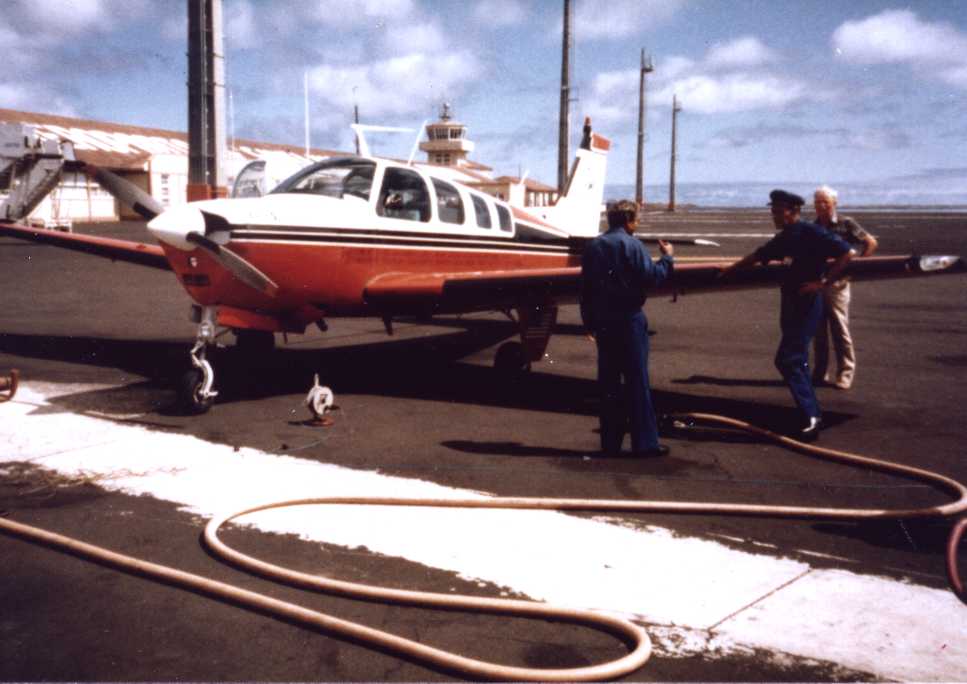
Refueling at Santa Maria
(Victor at right with white hair)
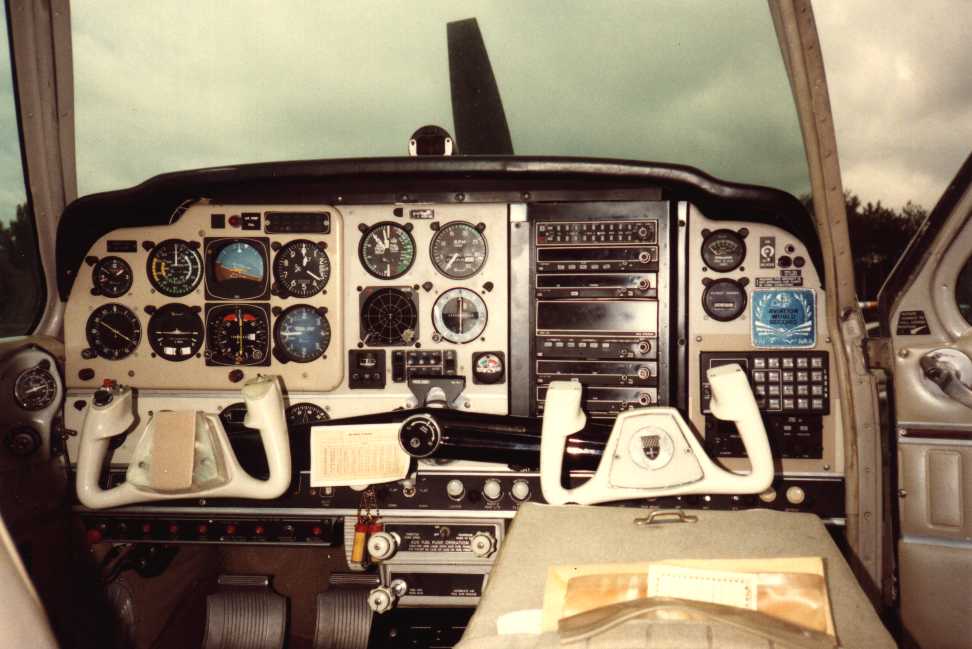
Panel
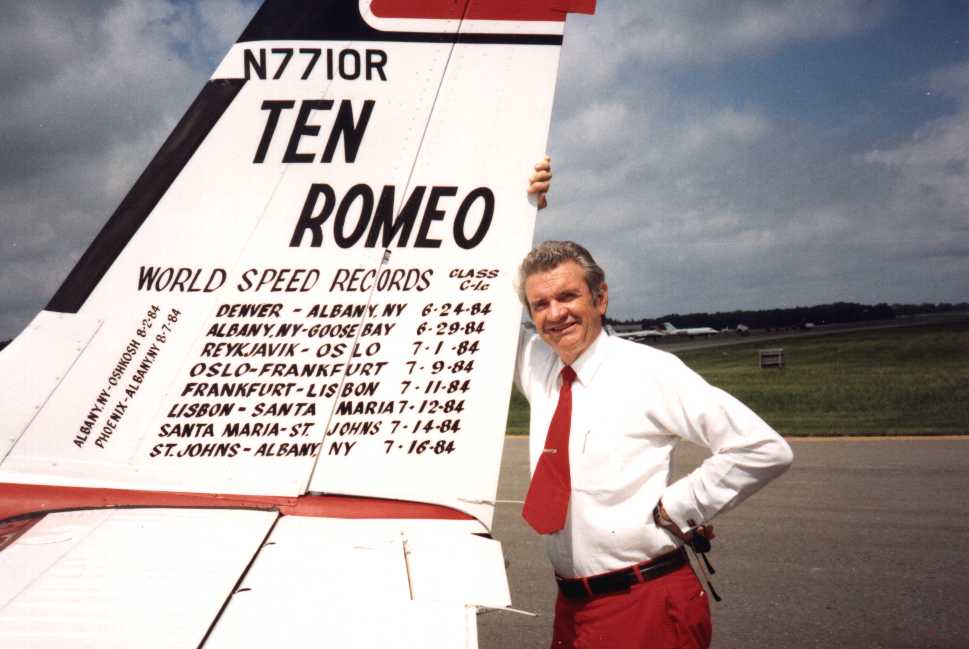
New Tail Paint
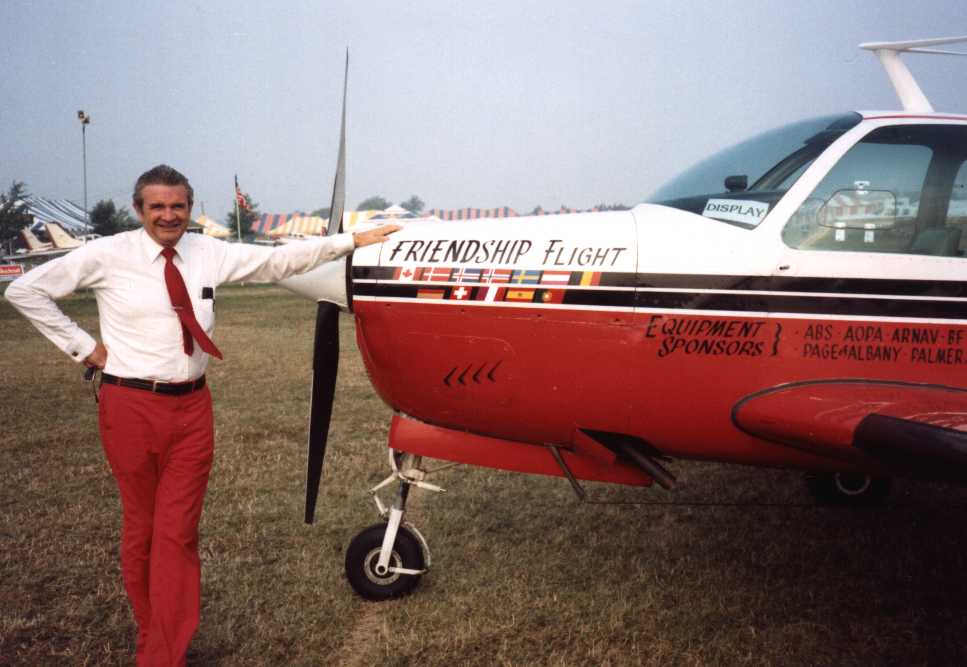
Flags (Taken at Oshkosh)